
One of the most common questions we receive is:
“Do I need three-phase power to run an electric sauna heater?”
In most cases in Ireland and the UK, the answer is no.
The confusion comes from the way heater manuals, electricians, and online information describe electrical connections. This article explains clearly how electric sauna heaters are actually connected in typical Irish and UK homes and what really matters for a safe installation.
Understanding 230 V and 400 V
Ireland and the UK use the same electrical system as most of Europe.
A three-phase supply consists of three individual 230 V phases. Between two phases you measure 400 V. Between one phase and neutral you measure 230 V.
Most houses in Ireland and the UK do not receive all three phases. They receive only one of them:
- Phase
- Neutral
- Earth
This is called single-phase 230 V supply and it is completely normal for residential properties.
How Electric Sauna Heaters Are Built
Many modern electric sauna heaters from manufacturers such as Harvia and HUUM are designed so they can be connected either to single-phase 230 V or three-phase 400 V supplies.
Inside these heaters there is typically a terminal block with connections marked U, V, W, N and PE.
In heaters that support both connection types, three-phase operation uses L1, L2 and L3 separately, while single-phase operation is achieved by bridging U, V and W together as shown in the manufacturer’s wiring diagram.
In these cases, no special “single-phase heater” is required. Only the wiring configuration changes.
Why People Think Three-Phase Is Required
In most sauna manuals you will see tables showing cable sizes and fuses only for 400 V three-phase connections. This is because in Finland, Germany, Estonia and other countries, three-phase is common in homes and is considered the standard way to connect a sauna.
However, the wiring diagram in the same manual also shows that 230 V single-phase is allowed by bridging the terminals.
The table shows the typical case. The wiring diagram shows all allowed cases.
The Real Limitation in Irish and UK Houses
The limitation is not the heater. It is the main service fuse of the house.
Most homes in Ireland and the UK have a 60–63 A main fuse for the entire house.
The current drawn by a heater is calculated as:
Current = Power ÷ Voltage
Examples:
- 6 kW heater on 230 V uses about 26 A
- 9 kW heater on 230 V uses about 39 A
- 10.5 kW heater on 230 V uses about 46 A
- 12 kW heater on 230 V uses about 52 A
An electrician becomes uncomfortable when a single appliance uses most of the 60–63 A available for the whole house. This is where the common “9 kW rule” comes from.
It is not a manufacturer limit. It is a practical comfort zone for electricians.
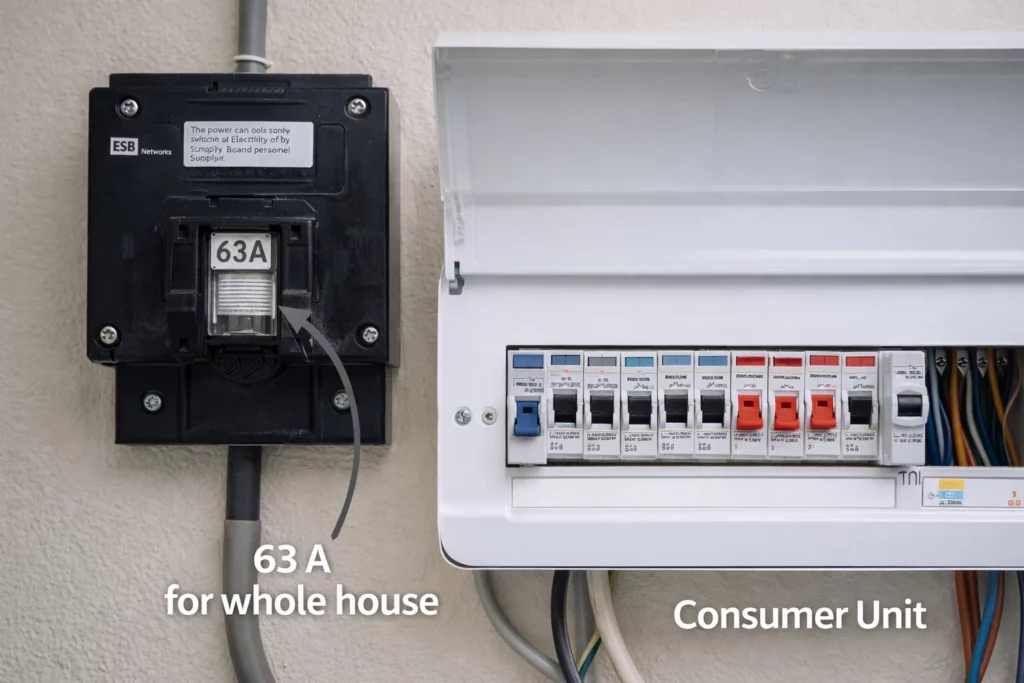
There Is No True 9 kW Barrier
Manufacturers such as Harvia clearly show in their manuals that 10.5 kW and 12 kW heaters may be connected to 230 V single-phase. They publish the required cable sizes and fuse ratings.
The reason electricians often say “above 9 kW you need three-phase” is because they want to avoid overloading the house supply, not because the heater cannot run on 230 V.
Solutions If a Larger Heater Is Desired
If a customer wants a 10.5 kW or 12 kW heater, there are standard solutions used by electricians in Ireland and the UK.
A service fuse upgrade (where permitted by the network operator) from 60–63 A to 80 A is common for EV chargers and heat pumps and may also make larger heaters practical.
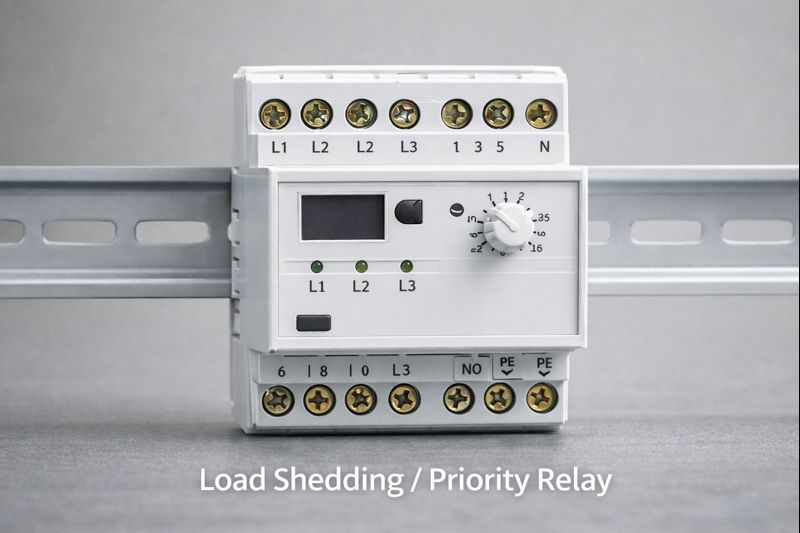
A load-shedding or priority device can be installed. This monitors the total house load and temporarily switches the sauna heater off if the house load becomes too high. This guarantees the main fuse will never be overloaded.
These are normal electrical solutions and are familiar to qualified electricians.
What Your Electrician Needs to Check
For any electric sauna heater installation, the electrician should check:
- Main service fuse rating at the meter
- Cable length from consumer unit to sauna
- Correct cable cross section
- Correct breaker size
- Other large loads in the house such as EV chargers or electric showers
Up to around 9 kW, most Irish and UK homes can accommodate the heater on standard single-phase supply without any changes.
Above this, the electrician may recommend one of the solutions described above.
Practical Summary
- Most homes in Ireland and the UK have single-phase 230 V supply
- Most Electric sauna heaters are designed to work on both single-phase and three-phase
- Up to about 9 kW is usually straightforward on standard supply
- Larger heaters are still possible with proper electrical assessment
- The limitation is the house main fuse, not the heater
Important technical note
Some electric sauna heaters are internally designed as true three-phase appliances. In these heaters, the heating elements are permanently distributed across three phases and cannot be bridged for single-phase operation.
This applies for example to certain models in the Harvia Top Steel series (such as M80 and M90). These heaters require a 400 V three-phase connection according to the manufacturer’s specifications and cannot be operated on 230 V single-phase.
Other heater models, such as the Harvia Cilindro range or most HUUM electric heaters, are designed so that the heating elements can be connected either in three-phase or in single-phase configuration, as shown in their wiring diagrams.
Always Use a Qualified Electrician
All electric sauna heaters must be installed by a qualified electrician. The electrician will confirm the correct cable, breaker, and suitability for your specific house.
If you are unsure which heater size is appropriate for your property, we are happy to discuss this with you before purchase so there are no surprises at installation time.
