
When researching outdoor wellness products, many people encounter the terms Jacuzzi, Hot Tub, and Whirlpool. These words are often used interchangeably, but technically they describe different things. The confusion increases further when bubble systems and hydro massage jets are added to the discussion.
This article explains all terms clearly and shows how bubble systems and hydro massage relate to Jacuzzis, hot tubs and whirlpools.
What Is a Jacuzzi?
Jacuzzi is not a category. It is a brand name.
The Jacuzzi company pioneered early hydrotherapy systems, and over time the brand name became widely used as a generic term. Today, many people refer to any spa with jets as a “Jacuzzi”, even when the product is manufactured by a different company.
Technically, a Jacuzzi refers to:
- a branded product,
- typically made from acrylic,
- equipped with pumps, filters and water jets,
- strongly focused on hydro massage.
In everyday language this usage is common, but from a technical and legal standpoint it is imprecise.
What Is a Hot Tub?
Hot tub is the correct generic term.
A hot tub is any tub designed to hold heated water for relaxation. This includes a wide range of products, from very simple wooden tubs to highly technical acrylic spas.
A hot tub can be:
- wooden or acrylic,
- heated electrically or by wood stove,
- completely without jets,
- equipped with air bubble systems,
- equipped with hydro massage systems,
- or a combination of both.
Because of this flexibility, hot tub is the most accurate umbrella term.
What Is a Whirlpool?
Whirlpool refers to a specific function, not to the tub itself.
A whirlpool exists when water is actively circulated through water jets, creating pressure, movement and targeted massage. This effect cannot be produced by air alone.
From a technical perspective:
- a whirlpool always requires hydromassage (water jets),
- a system without water jets is not a whirlpool,
- air bubbles alone do not create a whirlpool effect.
In some languages, “whirlpool” is used loosely to describe any spa, but strictly speaking the term applies only when water jets are present.
Bubble System (Air Jets) Explained
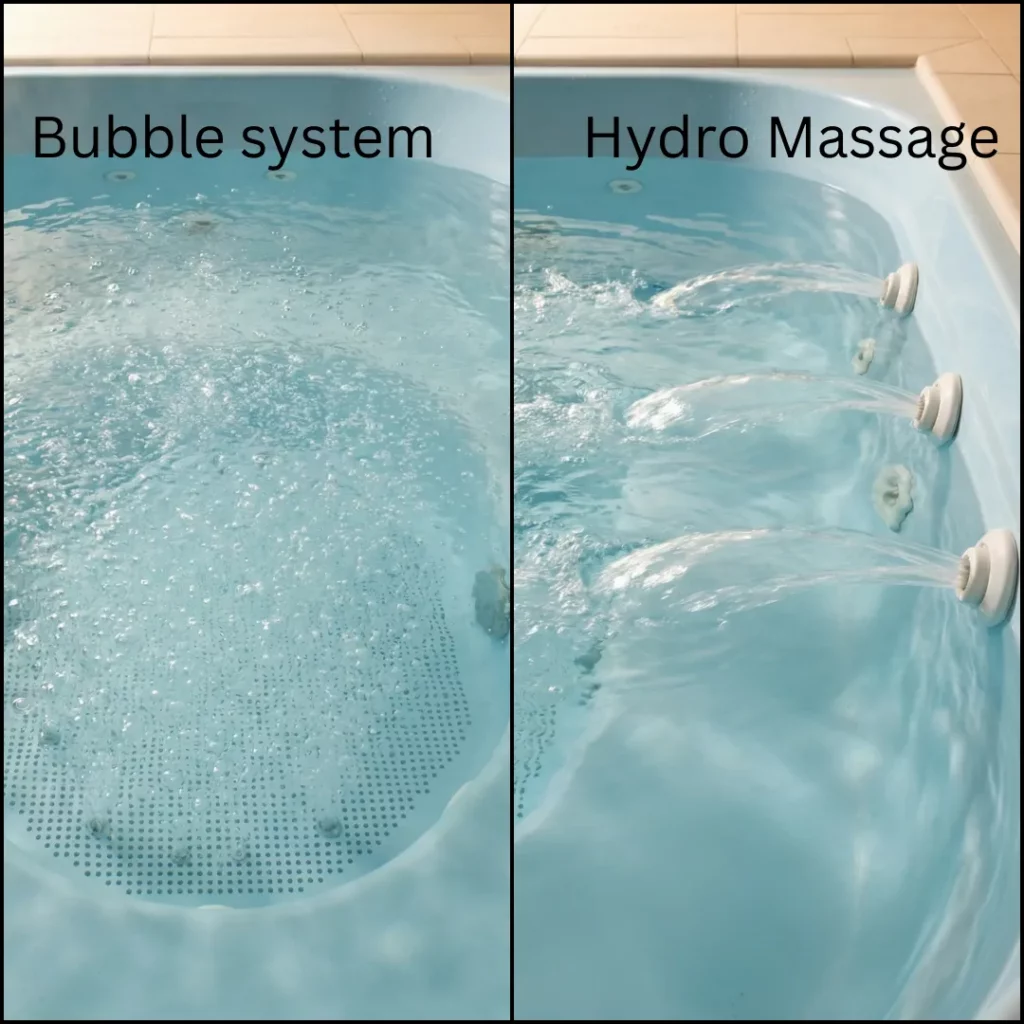
A bubble system, also called air jet system, uses a blower to push warm air through small openings in the floor or lower side walls of the hot tub. Thousands of fine bubbles rise evenly through the water.
Key characteristics:
- very gentle stimulation,
- evenly distributed bubbles,
- no directional pressure,
- no deep muscle massage.
Bubble systems are designed for comfort and relaxation, not for therapy. The sensation is light and calming rather than intense.
From a technical and maintenance point of view, bubble systems are:
- mechanically simpler,
- quieter than water jet systems,
- easier to maintain,
- less prone to long-term wear.
A hot tub with only a bubble system remains a hot tub, not a whirlpool.
Hydro Massage (Water Jets) Explained
Hydro massage systems work with water pumps, forcing heated water through adjustable jets positioned along the back, shoulders, legs or feet.
Key characteristics:
- targeted pressure on specific muscle groups,
- adjustable jet direction and strength,
- deeper muscular stimulation,
- stronger mechanical complexity.
Hydro massage systems are designed for:
- muscle relaxation,
- recovery after physical activity,
- hydrotherapy-style use.
Because they rely on pumps, seals and pipework, water jet systems are:
- louder than air systems,
- more complex,
- more maintenance-intensive over time.
Whenever water jets are present, the hot tub also qualifies as a whirlpool.
How Bubble Systems and Hydro Massage Relate to the Main Terms
The relationship between the terms can be summarized clearly:
A hot tub is the overall category and may have no jets, air bubbles, water jets, or both.
A whirlpool is a hot tub that includes hydro massage (water jets).
A Jacuzzi is a branded hot tub that typically emphasizes hydro massage performance.
A bubble system alone does not make a whirlpool.
Hydro massage always does.
Combined Systems: Bubble and Hydro Massage Together
Many modern spas combine both technologies:
- hydro massage for targeted muscle treatment,
- bubble systems for gentle relaxation.
This allows users to switch between different experiences. However, combined systems also increase:
- system complexity,
- energy consumption,
- servicing requirements.
For some users this flexibility is desirable. For others, simplicity and reliability are more important.
Choosing the Right System in Practice
The decision is not about terminology, but about intended use.
A simpler hot tub without jets or with a bubble system suits users who:
- want quiet relaxation,
- prefer low maintenance,
- value long-term reliability.
A whirlpool with hydro massage suits users who:
- actively want massage,
- seek muscle relief,
- accept higher technical complexity.
Brand names matter far less than system design, insulation quality and after-sales support.
Conclusion
All Jacuzzis are hot tubs.
All whirlpools are hot tubs with hydro massage.
Not all hot tubs are whirlpools.
Bubble systems enhance comfort but do not create a whirlpool effect. Hydro massage systems define whether a hot tub qualifies as a whirlpool.
Understanding these distinctions helps buyers choose the right product based on usage, maintenance expectations and long-term ownership rather than on terminology alone.
