
Sauna heater stones are a critical functional component of every Finnish sauna. They store heat, distribute it evenly throughout the sauna room and enable a controlled, pleasant steam when water is poured over them. Incorrect stone selection or improper layering directly affects steam quality, energy efficiency and the service life of the sauna heater.
This article explains which sauna stones are suitable, how they should be layered correctly and how requirements differ between electric and wood-fired sauna heaters.
Why sauna heater stones are essential
Sauna stones act as thermal storage and as a buffer between the heat source and the sauna room. They stabilize temperature behavior and ensure that water evaporates evenly during a sauna infusion. Without correctly installed stones, steam becomes harsh and uncontrolled, heat distribution suffers and the heater is exposed to unnecessary thermal stress.
Which sauna stones are suitable for sauna heaters?
Sauna stones for electric sauna heaters
Electric sauna heaters generate heat via heating elements operating within a controlled temperature range. The stones are primarily exposed to repeated heating and cooling cycles.
Suitable stones must be dense, resistant to thermal cycling and have smooth surfaces to avoid mechanical stress on the heating elements. Commonly used stone types include peridotite, diabase and olivine diabase.
Equally important is a uniform stone size and correct placement to ensure airflow without exerting pressure on the heating elements.
Sauna stones for wood-fired sauna heaters
Wood-fired sauna heaters operate under much harsher thermal conditions. Combustion produces very high temperature peaks combined with strong fluctuations.
In practice, the same stone types such as peridotite or sauna diabase are typically used. The key difference lies in stone size and grading. Wood-fired heaters require larger, more robust stones that can absorb thermal shock and withstand sudden temperature changes without cracking.
Electric vs wood-fired heaters – what really differs with the stones?
The difference is not the stone material itself, but rather:
- stone size (grading)
- stone distribution
- layering method
Electric sauna heaters require stone sizes that allow sufficient airflow while avoiding mechanical stress on the heating elements.
Wood-fired heaters tolerate larger, coarser stones that better absorb extreme temperature peaks and thermal stress.
In both cases, proper layering is essential for safe operation and consistent sauna performance.
Can water enter the firebox without stones?
The firebox of a wood-fired sauna heater is structurally closed. Water poured during a sauna infusion cannot enter the combustion chamber directly.
However, sauna stones protect surrounding extremely hot metal components such as the firebox top plate, flue gas channels and structural transitions. Without stones, water may hit these surfaces directly, causing instant evaporation, severe thermal stress and aggressive steam bursts.
The stones ensure delayed, controlled evaporation and protect the heater from unnecessary material fatigue.
Correct layering of sauna heater stones
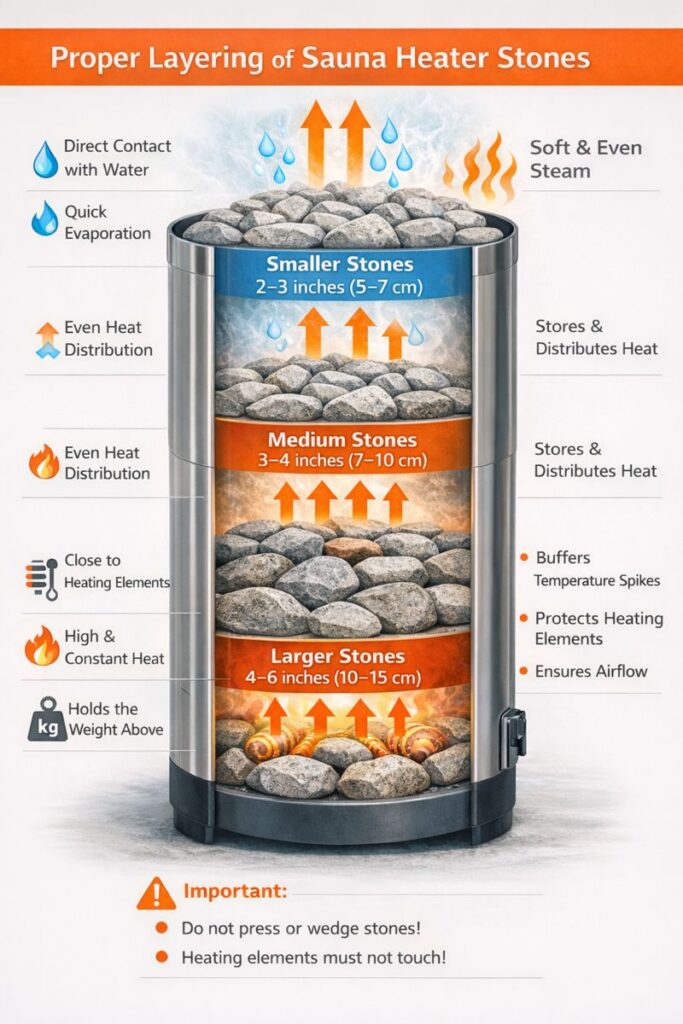
Larger stones belong in the lower section of the heater, smaller stones in the upper section.
The lower area experiences the highest temperatures. Larger stones provide higher thermal mass, withstand heat better and maintain sufficient airflow.
The upper area benefits from smaller stones, which increase surface area and allow water to evaporate evenly during infusion.
Stones must never be tightly packed or wedged. Free air gaps are essential for proper airflow.
Are the stones at the bottom really hotter?
Yes. The lowest section of the sauna heater is physically the hottest area because the heat source is located there.
For this reason, larger and more robust stones are required at the bottom. Small stones in this zone would overheat, deteriorate faster and impair airflow, leading to inefficient operation and increased heater wear.
Common mistakes when using sauna stones
Using decorative or river stones
→ risk of cracking or exploding
Stacking stones too tightly
→ restricted airflow and poor steam quality
Using stones that are too small at the bottom
→ overheating and reduced heater lifespan
Installing stones without washing them first
→ dust, odors and residue during initial heating
How often should sauna stones be replaced?
For electric sauna heaters in private use, stones should be inspected every two to three years. With frequent or commercial use, annual inspection is recommended.
Wood-fired sauna heaters place greater stress on stones. Annual inspection is advisable, and replacement is often necessary after one to two years.
Regardless of time interval, stones must be replaced if they show cracking, crumbling or heavy discoloration.
Maintenance and inspection of sauna stones
At least once per year, stones should be removed, damaged stones discarded, dust and abrasion cleaned out and the remaining stones re-layered loosely. This simple maintenance step significantly improves steam quality and extends the lifespan of the sauna heater.
Conclusion
Sauna heater stones are not a minor accessory, but a core functional component of any sauna. The correct stone material, appropriate stone size, proper layering and regular maintenance directly determine heat quality, steam comfort, energy efficiency and heater durability.
Careful selection and correct installation pay off through better sauna performance and reduced long-term costs.
