
When planning or buying a garden sauna, one of the most common questions is:
What sauna heater size do I need – and what are the sauna running costs?
The right sauna heater calculation depends on many factors. Below, we explain the most important ones, grouped into categories, and show which have the biggest impact on sauna energy costs.
If you are primarily interested in the detailed breakdown of sauna running costs per session, we recommend our dedicated guide here.
1. Sauna Construction
Heated Volume (very high impact)
The sauna volume is the key driver of heater size and sauna energy consumption. Every additional cubic meter of air requires proportionally more heating power.
Wall Thickness and Insulation (very high impact)
Thin or poorly insulated walls lead to high sauna running costs. Proper insulation and thicker walls significantly reduce energy demand.
Windows and Doors (medium impact)
Glass surfaces are thermal bridges. A large single-glass window can increase sauna energy costs, while modern double glazing minimizes losses. Poorly sealed doors add further inefficiency.
Floor and Foundation (low to medium impact)
Uninsulated concrete drains heat quickly. A wooden base or insulated foundation improves efficiency.
Roof Shape and Geometry (medium impact)
Barrel saunas distribute heat evenly and often need less energy. Rectangular saunas lose more heat due to uneven distribution.
2. Location and Climate
Outdoor Temperature (very high impact)
The colder the climate, the higher the sauna heater size needed. Winter use drives up sauna running costs significantly.
Wind Exposure (medium impact)
Wind increases heat losses. A sheltered garden position helps reduce energy costs.
Connection to a Building (medium impact)
Freestanding saunas lose more heat than saunas attached to a house or shed.
Humidity and Climate Zone (low impact)
Moisture affects sauna comfort more than sauna heater calculation.
3. Heater and Technology
Sauna Heater Size (fundamental, decisive)
Correct heater sizing ensures performance and efficiency. An undersized heater will never reach temperature, while an oversized one wastes energy.
Efficiency of Wood Stoves (medium impact)
Modern wood stoves are more fuel efficient. Outdated models consume more wood for the same sauna running costs.
Controls and Starting Temperature (low to medium impact)
Digital thermostats optimize sauna heater calculation. Starting from freezing conditions consumes more energy than starting from mild temperatures.
4. Use and Operation
Desired Indoor Temperature (very high impact)
Running a sauna at 95 °C costs much more than at 70 °C.
Heating Time and Duration of Use (medium to high impact)
The longer the sauna is kept hot, the higher the energy costs. Efficient use and avoiding unnecessary preheating saves money.
Door Openings (low impact)
Frequent openings increase running costs slightly, but the effect is minor.
Number of Users (low impact)
Body heat adds a small effect, but door use offsets this.
Maintenance Condition (low to medium impact)
Clean, well-maintained sauna heaters with the right number of stones work more efficiently.
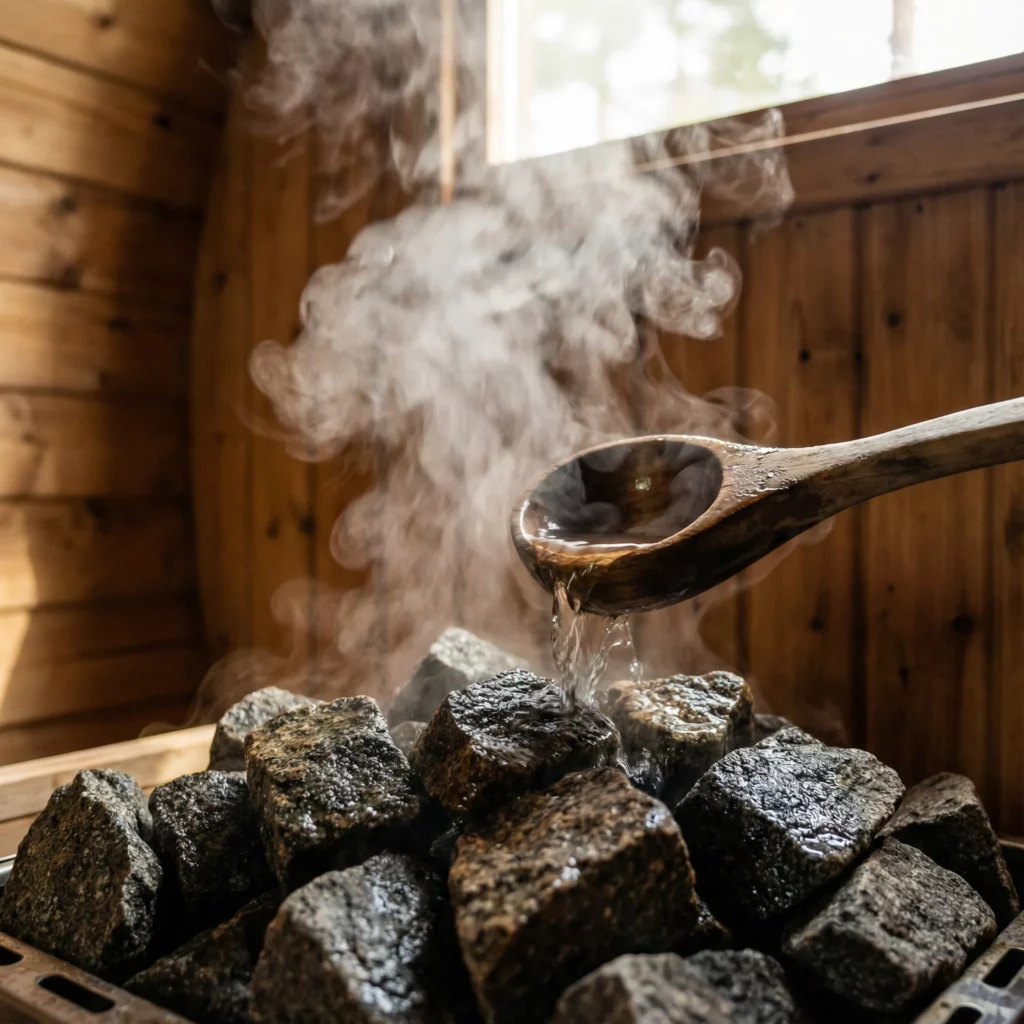
5. Sauna Stones: A Hidden Factor
The number of stones in the heater does not affect external heat losses, but it determines how energy is distributed over time.
Large Stone Quantity (e.g. 60–100 kg)
Higher sauna energy costs at the start due to heating heavy stone mass.
Stable heat release and lower running costs once hot.
Ideal for long sessions and strong steam infusions.
Small Stone Quantity (e.g. 15–25 kg)
Faster and cheaper to heat up.
Higher running costs during the session due to frequent reheating.
Best for quick sauna use.
In summary:
Many stones = higher start-up costs, lower running costs over time.
Few stones = lower start-up costs, higher running costs during use.
Why Sauna Heater Calculation Is So Complex
Saunas are transient heating systems. At first, cold air, stones, and walls need to be heated. Then, heat constantly escapes while stored energy in walls and stones flows back.
This makes exact sauna heater calculation by hand nearly impossible. Even computer models can only estimate real sauna running costs, since they cannot perfectly reflect door openings, steam infusions, and user behavior.
Sauna Heater Size: The Practical Rule of Thumb
To provide a clear orientation, use these rules:
Electric sauna heater size: about 1 kW per m³ of sauna volume (normal walls and small glass surfaces). Add 10–20 % for poor insulation or large windows.
Wood sauna heater size: because wood stoves are less efficient, calculate with 1.3 × volume (m³).
Example: A 10 m³ sauna needs not 10 kW, but about 13 kW wood stove capacity.
This simple rule does not cover every detail but provides a reliable guide for choosing the right sauna heater size and estimating sauna energy costs.
Conclusion: Sauna Running Costs in Perspective
Most important: sauna volume, insulation, outdoor temperature, desired heat.
Relevant but secondary: windows, wind, use duration, stone mass.
Minor: door openings, number of users, humidity, heater maintenance.
Careful sauna heater calculation in the planning stage reduces sauna running costs significantly and ensures a perfect wellness experience.
For detailed examples of sauna running costs per hour, including electricity and firewood calculations, see our full article here.
